


Pre-Purchase Examination in the Horse, Looking Beyond “Pass or Fail”
Updated: Mar 22
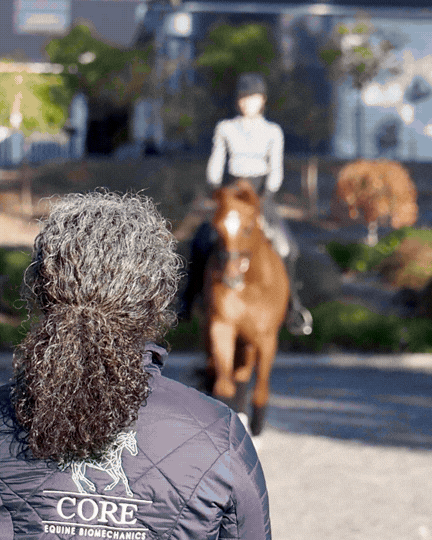
A pre-purchase examination in the horse is often described as a pass or fail assessment. In practice, it is neither. It is a structured clinical evaluation designed to describe the horse’s current musculoskeletal and general health status, and to support informed decision-making.
The value of a pre-purchase examination lies not in eliminating risk, but in identifying and contextualising it. The goal is to identify findings, explain their relevance, and contextualise risk in relation to the buyer’s intended use, performance expectations, and tolerance for ongoing management.
The Purpose of a Pre-Purchase Examination in Horses
A pre-purchase examination provides a clinical snapshot of the horse on the day of assessment.
It aims to:
Identify existing lameness or asymmetry
Detect findings that may influence performance
Assess how the horse responds to increasing load
Support discussion around suitability and risk
The examination informs the buyer and facilitates their decision making based on the findings on the day and the information provided to us as the examining veterinarian.
The Five-Stage Pre-Purchase Examination
Pre-purchase examinations are performed using a staged process. This allows findings to be interpreted progressively rather than in isolation.

Stage 1: Examination at Rest
General health assessment including listening to the heart for any murmurs, listening to the respiratory and garstrointestinal tract and assessment of the skin.
Examination of the eyes and cranial nerves
Evaluation of conformation, posture, and muscle symmetry
Palpation of limbs, neck, and thoracolumbar spine
Identification of heat, swelling, pain, or reduced range of motion
Stage 2: Gait Assessment
Baseline gait assessment on a firm, level surface
Evaluation of symmetry and consistency
Identification of subtle or bilateral movement changes
Stage 3: Strenuous exercise
Observation under increased workload to raise the heart and respiratory rate, to allow checking for abnormal heart rhythms, breathing issues, and soundness under load.
Evaluation of movement quality, transitions, and tolerance to load
Flexion tests and any further targeted assessments indicated by earlier findings.
Flexion tests apply controlled stress to specific joints or regions, followed by immediate reassessment of gait. The aim is not to determine suitability in isolation, but to observe how joints and soft tissues respond to increased load.

Flexion responses are influenced by:
Age and training history
Recent workload and conditioning
Surface conditions
Whether findings are unilateral or bilateral
Stage 4: Recovery & Re-Examination After Exercise
Reassessment of gait following exertion
Identification of stiffness or delayed onset lameness
Comparison with pre-exercise findings
Stage 5: Final Assessment
A final examination of the horse at walk and trot to check for any lameness or stiffness that has appeared after strenuous exercise.
All of the information from the assessment is pooled to provide an opinion of further investigations that should be performed relative to the buyer’s intended use of the horse.
Where indicated, additional diagnostics such as radiographs, ultrasound, or blood sampling may be recommended to further contextualise findings.
Contextualising the Findings

The most important part of a pre-purchase examination occurs after the physical assessment.
Findings are discussed in relation to:
Intended discipline and level
Short- and long-term performance goals
Expectations regarding resale value
The buyer’s tolerance for risk
Likelihood of future management or intervention
A finding that represents acceptable risk for one buyer may be inappropriate for another. Context determines significance. and no horse is without risk. As such, the goal of a PPE is not to eliminate risk, but to define it.
Risk Assessment, Not Prediction
A pre-purchase examination cannot predict the future. Horses are athletic individuals, and soundness is influenced by training progression, rider influence, management practices, and cumulative load over time.
The veterinarian’s role is to:
Identify clinical findings
Explain potential implications
Outline the level of risk
Support informed decision-making
This approach allows buyers to proceed with realistic expectations and clarity around future management.
Where subtle asymmetries or risk factors are identified, ongoing objective monitoring can provide additional context beyond a single assessment. Patient monitoring over time, particularly using objective gait technology, can be highly valuable to detect subtle changes. To learn more about how we do this, visit out Gait Assessments page.
Remote Screening Before a Pre-Purchase Examination
For buyers seeking early insight before committing to a full veterinary pre-purchase examination, a remote gait screening option is available.

Objective gait analysis using submitted video can:
Identify obvious asymmetries prior to scheduling a full PPE
Support screening decisions in interstate or remote purchases
Provide baseline movement data before the veterinary visit
Assist in determining whether a full pre-purchase examination is indicated
Remote screening does not replace a formal veterinary pre-purchase examination. However, it can offer preliminary insight and support more informed planning.
You can read more about how this works in our blog on Remote Gait Assessments.
A pre-purchase examination in the horse is not a pass or fail test. It is a structured, staged clinical assessment designed to support informed decisions.When interpreted in context, a PPE provides valuable insight into current soundness, future risk, and management considerations. The final decision always rests with the buyer, guided by clear information and realistic expectations.
If you decide to proceed with purchase, structured rehabilitation and progressive loading become critical in shaping long-term outcomes. The EqActive Rehab Book outlines practical, evidence-informed principles to support horses following assessment or changes in workload.


Comments